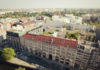
Ozone, IN/OUT, Carré Édouard VII, Cézanne Saint Honoré, Washington Plaza, le Louvre des Entreprises… des noms majestueux pour des immeubles d’exception. Ceux-ci appartiennent à la Société Foncière Lyonnaise, acteur clef du marché immobilier de la capitale. Avec un patrimoine de 3,2 milliards d’euros d’actifs et 357 700 m2 sur Paris et sa petite couronne, la société s’est spécialisée dans la location haut de gamme de bureaux et de commerces. Elle en détient pas moins d’une vingtaine, dont une majorité centrée sur le quartier central des affaires parisien(1) et le croissant Ouest de Paris. « En tant que société foncière, notre métier consiste en l’acquisition, la location, l’évolution et le maintien des immeubles, souligne Marc Stravopodis, directeur commercial SFL. Dans chacune de nos activités, nous visons l’excellence pour nos clients. »
La Société Foncière Lyonnaise compte parmi ses emplacements prestigieux le Carré Édouard VII situé entre l’Opéra Garnier et la Madeleine, quartier qui s’étend sur un hectare et demi avec une importante concentration d’entreprises internationales notamment, mais aussi le théâtre Édouard VII et l’Olympia, le Louvre des Entreprises et le Louvre des Antiquaires, le Washington Plaza près des Champs-Élysées ou encore Rives de Seine, en bordure du fleuve, à la Gare de Lyon. Sans oublier les immeubles aux 112 et 131 avenue de Wagram, au 96 avenue d’Iéna, au 6 rue de Hanovre, au 103 rue de Grenelle…
« Nos choix sont guidés par nos clients, par leur évolution, par leurs objectifs et leurs problématiques, ajoute Marc Stravopodis. Nous sommes à leur écoute pour que le bâtiment soit agréable et efficient, pour qu’il permette de créer un esprit d’entreprise. » Les locataires se chargent ensuite de la décoration intérieure de leurs parties privatives. Chaque immeuble de SFL se veut conforme aux meilleurs standards internationaux. Les principes du développement durable sont intégrés dans les choix stratégiques de la société foncière. « Ces dernières années, nous constatons un important mouvement des entreprises vers le quartier central des affaires de Paris », observe Marc Stravopodis.
Pour le directeur commercial, cette tendance se justifie par la volonté des sociétés de fidéliser leurs collaborateurs, d’attirer de nouveaux talents, mais aussi de valoriser leur image client. « Les entreprises veulent garantir à leurs employés une situation de travail idéale, pour qu’ils se sentent bien grâce à un environnement qualitatif. » De même vis-à-vis de leurs clients, un positionnement central renforce leur attractivité. SFL séduit ainsi par ses atouts haut de gamme des locataires qui évoluent dans les domaines du droit, de la finance, de l’industrie ou encore des services tels que les groupes Freshfields, Natixis, Citibank, Valtec, Barilla, l’Autorité européenne des marchés financiers (ESMA), Zurich Assurances, Lagardère, Constellium ou Facebook. Une diversité de secteurs d’activité qui lui permet de se préserver des aléas de la conjoncture économique. « Les entreprises étrangères apprécient l’architecture parisienne tout en souhaitant des immeubles offrant des caractéristiques modernes », analyse Marc Stravopodis.
(1) Le quartier central des affaires est un pôle situé entre la porte Maillot et la rue du Louvre et s’étendant ainsi sur les 17e, 8e et 2e arrondissements. Cette zone concentre les bureaux les plus chers de Paris.
(2) Nous prenons soins de vos talents
Chiffres clés
3,2 milliards d’euros d’actifs immobiliers.
357 700 m2 d’immeubles répartis sur une vingtaine de sites.
82 % du patrimoine concentré dans le quartier central des affaires.
Trois positionnements en petite couronne: Neuilly-sur-Seine, Boulogne-Billancourt, Issy-les-Moulineaux.
Société placée sous le régime fiscal des SIIC (Sociétés d’Investissements Immobiliers cotées) depuis 2003, SFL est détenue aujourd’hui à 54 % par Colonial et 15 % par le Crédit Agricole.